Gerrit Jan Wilpshaar
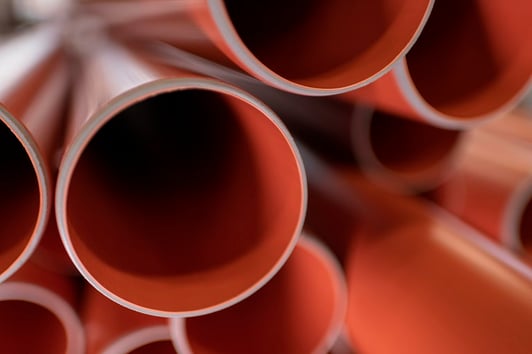


Multilayer pipe structures, such as foam core pipes, are a type of sandwich pipe primarily used for pressure-less applications. This design replaces the rigid honeycomb structure often used in plates with a foam core. The multilayer approach lets you place the "right material at the right place," such as using different materials in the core and skin layers.
Construction and Materials
Foam core pipe is a structured-wall pipe type that most closely resembles a standard solid-wall pipe. This design offers significant weight savings while maintaining stiffness, as it moves material away from the center of the wall, where it is less effective at resisting bending loads. The core layer often utilizes lower-grade materials, including post-consumer recycled PVC pipe material. The core can also incorporate fillers such as CaCO3.
In a simplified solid-wall section with uniform material properties, the outer 50% of the wall thickness (the two outer quarters combined) contributes 87.5% of its second moment of area in bending. This illustrates why the central core can incorporate recycled or foamed PVC while the solid inner and outer skins provide much of the bending stiffness. Actual pipe stiffness also depends on the properties of the individual layers, core shear resistance, and overall wall geometry.
Advantages of Multilayer Design
Using recycled materials and fillers in the core reduces costs and supports sustainability. The core carries only a fraction of the load compared to the outer layers, making it a suitable location for lower-grade or recycled materials. Replacing polymer with filler or gas (foaming) considerably reduces the amount of Carbon used over the pipe's lifespan. Higher filler levels can increase stiffness and may allow a thinner wall or more blowing agent without creating blisters, further reducing costs.
Regional Standards and Formulation
Standards for structured wall pipes, like EN13476, ISO 21138, and AS/NZS 1260, specify minimum PVC percentages in the core and skins. For example, EN13476 allows at least 60% PVC in the core and 75% in the skins, while AS/NZS 1260 requires at least 80% PVC. Other application-specific standards include ASTM F891 for coextruded PVC pipes with a cellular core, JIS K 9798 for PVC-U three-layer pipes with a recycled foamed core, and SANS 1601 for structured-wall PVC-U sewer pipes. Formulations for PVC foam core pipe often include CaCO3 (up to 15-20 phr) to compensate for foam's lower stiffness. Using recycled PVC pipe grade (K67) for foaming presents more processing challenges than injection molding grade (K57).
Processing Recycled PVC in Foam Cores
Recycled PVC can be incorporated into the core of multilayer pipes, but stable production depends on material quality and formulation. Pipe-grade PVC with a K-value around 67 generally has higher melt viscosity and can be harder to foam than lower-K material such as K57. Adjustments to processing aids, lubrication and extrusion conditions may be required to achieve a consistent foam structure.
Post-consumer recycled PVC may also contain contaminants such as sand or rubber particles, which can affect processing stability and pipe quality. Reliable material sourcing, homogenization, appropriate particle-size reduction, and extrusion equipment suited to recycled PVC help manage these challenges.
For more information, read our article on the Effect of Recycled PVC on Pipe Quality.
Technical Considerations
- Core Material: Can include post-consumer recycled PVC or high levels of fillers like CaCO3.
- Stiffness Compensation: CaCO3 addition (e.g., up to 15-20 phr for PVC foam core) compensates for foam stiffness reduction.
- Wall Thickness: Can be the same or thinner than solid wall equivalents at comparable stiffness.
Regional Requirements: Minimum PVC content in core/skins specified by standards like EN13476 (60% core, 75% skin), AS/NZS 1260 (80% core).