%20(1).jpg?width=30&height=30&name=240415597786%20(1)%20(1).jpg) Gerrit Jan Wilpshaar
Gerrit Jan Wilpshaar
%201-4.jpg)
%20(7).png?width=1406&height=819&name=Copy%20of%20Featured%20Image%20(450x263px)%20(7).png)
Die-head design has a major impact on pipe quality, material efficiency, and process stability. On this page, we compare traditional coathanger die-head technology with Rollepaal’s advanced branching technology for PVC pipe production.
Talk to an extrusion expertWhy die-head technology matters
In PVC pipe extrusion, it’s not enough to simply melt and push material through a die. The way the melt is distributed and compressed inside the die-head determines:
- Wall thickness uniformity around the circumference
- Weld line strength and overall pipe integrity
- Layer distribution in multi-layer pipes
- Material usage and the level of overweight
- Process stability when formulations or viscosity change
Choosing between a traditional coathanger-type die-head and a branching die-head directly affects all of these factors, and therefore production cost and pipe performance.
What is coathanger technology?
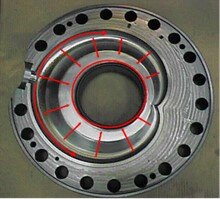
In a conventional coathanger die-head, the molten PVC enters the die through a central inlet and is spread out through a tapered manifold that resembles an inverted coathanger. The manifold is designed to balance pressure and velocity before the melt is formed into the final shape.
In a conventional coathanger die head, hot PVC enters through the middle and spreads out into a channel shaped like an upside-down coathanger. This channel is designed to keep the flow before the melt is formed into the final shape.
This technology is widely used in the plastics industry, especially for flat products like films, sheets, and coatings. For circular pipes, however, this design can lead to:
- Flow paths of different lengths around the circumference
- Local variations in wall thickness and layer distribution
- Higher material consumption due to “safety” overweight
- Sensitivity to changes in melt viscosity or formulation
What is branching technology?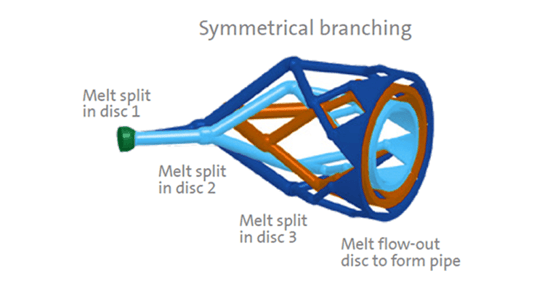
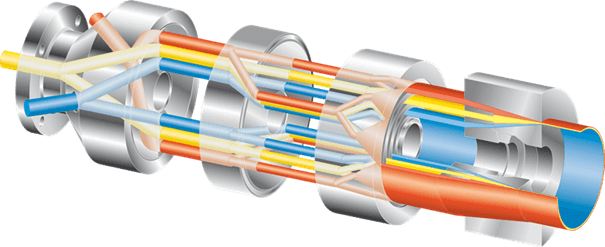
Rollepaal’s branching technology is specifically developed for the production of circular PVC pipes. Instead of distributing the melt from a single manifold, the flow is split into multiple symmetrical, short, round channels (branches) that feed the complete circumference.
Key design principles:
- Symmetrical branching: all flow paths have equal lengths, keeping layer thickness consistent around the pipe.
- Short, round channels prevent stagnation, reduce the risk of clogging, and make cleaning easy.
- No restrictor gap needed: there is no requirement for a melt-flow restrictor with varying gap lengths around the circumference, so the die is largely independent of changes in melt viscosity.
- Modular design: the same RMD die-head platform can be configured with single- or double-compression tooling and supports quick tool change.
In short, branching technology offers a modern, performance-driven alternative to traditional coat-hanger die-heads, delivering measurable savings and higher product reliability. The result is a die-head optimized for both multi-layer and solid-wall PVC pipes, enabling stable processing and significant material reduction. In many cases, weight savings of up to 10% can be achieved, delivering a return on investment in less than half a year. Below are the three key reasons to switch to branching: a clear technical and financial advantage.
1. Weight reduction
-
Branching provides much more uniform wall thickness, eliminating the need for excessive over-weight.
-
In real production, branching typically results in 3–4% material savings on solid-wall and multilayer PVC pipes.
-
This reduction alone often leads to an ROI of less than 1.5 years, depending on pipe range, output, and material costs. For larger diameters or high-volume production, the payback is even faster.
2. Even distribution of layers
Because branching uses symmetrical flow channels of equal length, every layer (inner, core, outer) follows the same path. This ensures:
-
-
Stable skin-core ratios, even with viscosity or formulation changes
-
Higher quality in foam-core and recycled-core structures
-
Less scrap caused by layer shifting or inconsistent distribution
-
3. Superior weld quality
Symmetrical branching and optionally Double Compression ensure the melt recombines under uniform deformation and pressure around the entire circumference. This delivers:
-
-
Stronger, more homogeneous weld lines, critical for pressure pipes
-
Reduced internal stress in the pipe
-
More reliable performance at higher outputs
-
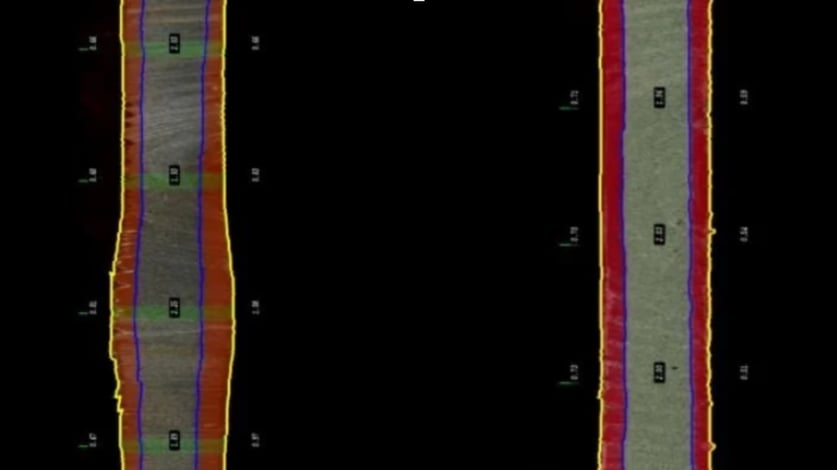
Below is an example from two pipes scanned with the Rollepaal Offline Multi-Layer Pipe Scanner.
-
Left: Pipe produced with traditional coathanger technology
-
Right: Pipe produced using branching technology
Branching vs coathanger:
| Criterion | Branching technology (Rollepaal) | Coathanger technology |
|---|---|---|
Flow distribution for circular pipes |
Symmetrical branching with equal flow path length leads to a very uniform distribution around the circumference. |
Flow from a single manifold can create unequal path lengths and local thickness variations in circular geometries. |
Wall thickness uniformity |
Excellent uniformity; minimal over-weight required, helping to reduce material cost while staying within standards. |
Greater risk of thick and thin spots; producers often run heavier pipes to ensure minimum wall thickness everywhere. |
Layer distribution in multi-layer pipes |
Precise layer distribution with a stable skin-core ratio; suitable for foam cores and up to 100% recycled core material. |
More difficult to keep the skin and core layers uniform around the circumference, especially when viscosity changes. |
Sensitivity to viscosity and formulation changes |
Layer distribution is largely independent of melt viscosity, as no circumferential restrictor gap is required. |
Requires tuning of gaps and process settings; more sensitive to formulation changes. |
Cleaning and maintenance |
Short, round branches and accessible channels make cleaning fast and straightforward, reducing downtime. |
More complex manifolds can be more challenging to clean and slower to clean, increasing the risk of downtime. |
Material savings |
Optimized layer distribution and accurate wall thickness enable significant savings. |
Higher and less predictable over-weight leads to unnecessary use of virgin PVC. |
Best suited for |
PVC and PVC-O pipe production, solid wall and multi-layer pipes, including foam core and high recycled content. |
Flat products (films, sheets), general coatings, and specific applications where circular symmetry is less critical. |
Where branching technology makes the biggest impact
Branching technology delivers the most value when you are:
- Producing pressure pipes that must meet stringent dimensional and performance standards
- Switching to multi-layer pipes with recycled core and high-quality virgin skins
- Working with foam core structures to reduce weight and material cost
- Running multiple formulations (K-values, stabilizers, recyclate blends) on the same line
- Looking to minimize changeover and cleaning time and maximize uptime
In these situations, traditional coathanger die-heads quickly reach their limits, while branching technology continues to deliver stable quality and predictable output.
Combining branching with Double Compression for superior pipe quality
Rollepaal integrates branching with its advanced Double Compression tooling in both multi-layer and solid-wall die-heads. The combination of symmetrical branching and controlled compression ensures:
- Consistent deformation and weld quality across the entire melt stream
- Stronger weld lines and reduced internal stress in the pipe
- Stable performance even at high outputs
This enables increased line speed, reduced scrap, and continued compliance with demanding quality requirements for PVC pipes.
Branching or Coathanger: Which technology is right for your line?
Every pipe producer has different requirements. Our experts can help you evaluate whether branching technology, combined with multi-layer or solid wall concepts, is the most efficient solution for your extrusion lines.
Want your current pipe scanned? Get in touch or Get Expert Consultation
%20(1)-4.png)
-Feb-06-2025-02-54-02-9992-PM.jpg)